
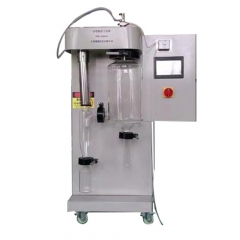
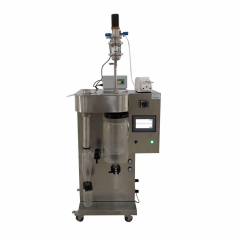
Equipo de secado de alta calidad para laboratorio de escala de 1.5 l.
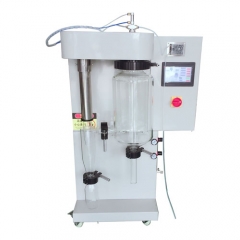
El secador por pulverización a escala de laboratorio es adecuado para la producción en universidades, institutos de investigación y empresas químicas farmacéuticas y de alimentos. & nbsp;
A closer look at how heating methods influence equipment design, installation requirements, and drying performance
When reviewing spray dryer quotations, customers often focus first on capacity, temperature range, and performance specifications. However, one question frequently appears during the evaluation process:
Why do two spray dryers with the same 25L capacity have completely different equipment dimensions?
Recently, a customer comparing two 25L spray dryer solutions noticed that the gas-heated model was significantly larger than the electric-heated version and required a larger installation area. The difference attracted attention because both systems were designed for the same drying purpose. So, what creates this difference?
Although the two machines look different from the outside, the internal drying principle remains the same. Both systems use the same spray drying process:
Liquid feed → Atomization → Hot air contact → Moisture evaporation → Powder collection

The key difference comes from how the hot air is generated. For a 25L spray dryer, the actual heat requirement is approximately 60,000 kcal/h during normal operation. However, gas heating systems require a suitable industrial burner configuration. In many cases, the smallest available burner size is around 100,000 kcal/h. Because of this, the gas heating design requires additional space for:
These additional components make the overall equipment larger.
The size difference is mainly related to engineering requirements. An electric heating spray dryer converts electrical energy directly into heat. The heating system is relatively compact and can be integrated into a smaller structure. A gas heating spray dryer, on the other hand, requires a complete combustion system. This includes not only the burner itself but also supporting components designed to ensure stable operation and meet safety requirements.
For customers planning installation, this means the gas heating model needs:
The larger footprint does not mean the machine uses a different drying technology.
It reflects a different approach to producing heat.


Electric heating Gas Heating
Another factor affecting spray dryer size is the drying chamber design. In spray drying, tower height influences the residence time of droplets inside the hot air stream.
A taller drying chamber allows:
For larger evaporation requirements, manufacturers often increase tower height and chamber volume. However, tower size and heating method are two separate design factors. A larger tower does not automatically mean the drying process is different.
The final drying performance depends on the complete system design, including:
The choice between electric and gas heating is usually determined by the customer's operating environment rather than drying technology.

Commonly considered for:
Main considerations:
Often selected by:
Main considerations:
The comparison between electric and gas heating spray dryers is not about which system is better. It is about choosing the right configuration for the working environment. A laboratory may prioritize compact design and easy operation, while a production facility may focus more on energy efficiency and continuous operation. Both systems can deliver reliable spray drying performance when properly configured.
As spray drying applications continue to expand across research and industrial fields, equipment selection is becoming increasingly focused on practical operation requirements. OLLITAL works with customers to evaluate factors such as heating source, installation conditions, material characteristics, and production goals to develop suitable spray drying configurations. From compact laboratory systems to customized production solutions, the objective remains the same:
Reliable drying performance, stable operation, and consistent powder quality.



 Servicio en línea
 +86 15960821529
 kevin@ollital.comkevinollital@gmail.com
 +86 15960821529
 +8615960821529


