

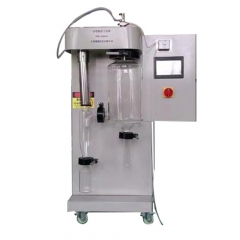
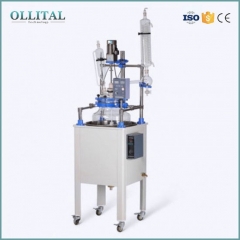
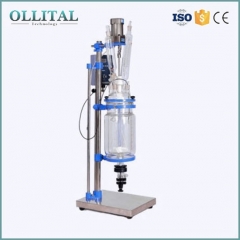
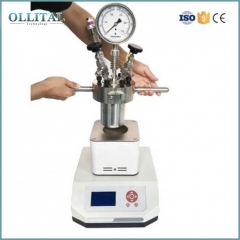
Equipo de secado de alta calidad para laboratorio de escala de 1.5 l.
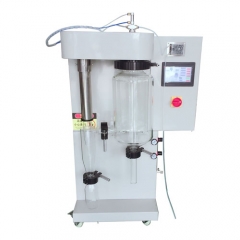
El secador por pulverización a escala de laboratorio es adecuado para la producción en universidades, institutos de investigación y empresas químicas farmacéuticas y de alimentos. & nbsp;
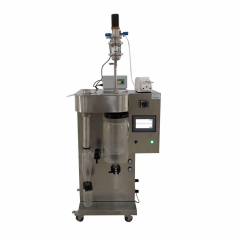
For researchers working with powders, achieving a consistent result is often more complicated than simply removing moisture from a liquid. The final powder characteristics can be influenced by temperature, feed rate, atomization conditions, airflow and the properties of the material itself.
As spray drying continues to find applications across research laboratories and pilot-scale processing, greater attention is being placed on process control. Rather than treating spray drying as a single drying step, researchers are increasingly looking at the entire process to understand how operating conditions affect the final product.
Spray drying works by breaking a liquid feed into small droplets and bringing those droplets into contact with a controlled stream of heated air. Moisture evaporates rapidly, leaving behind dry particles that can be collected from the drying system.
The principle is relatively straightforward, but the actual process can vary considerably from one material to another.
A solution containing dissolved solids may behave differently from a suspension or emulsion. Materials with different viscosities, concentrations and thermal sensitivities can also require different drying conditions.
This is why laboratory spray dryers are particularly useful during research and development. They allow operators to test different parameters on a small scale before considering larger production systems.
Temperature is often the first parameter considered when setting up a spray drying process. However, simply increasing the inlet temperature does not necessarily produce better results.
The relationship between inlet temperature and outlet temperature provides important information about how the material is responding during drying. Feed rate also plays a significant role. If liquid is introduced too quickly, the drying air may not have enough capacity to remove the required moisture.
On the other hand, an excessively low feed rate may reduce production efficiency and change the characteristics of the resulting powder.
For heat-sensitive materials, controlling the drying environment becomes even more important. Researchers may need to balance rapid moisture removal with protection of the material's desired properties.
The way liquid is atomized has a direct influence on droplet size, and droplet size affects drying behavior.
Smaller droplets generally have a larger surface area relative to their volume, allowing moisture to evaporate rapidly. The resulting particles may also have different characteristics compared with powders produced from larger droplets.
Depending on the application, researchers may adjust atomization conditions to explore changes in particle size, morphology and powder recovery.
This is one reason modern spray drying research often involves several rounds of testing rather than relying on a single fixed set of operating parameters.
One of the main advantages of laboratory spray drying is the opportunity to investigate process behavior before moving to larger equipment.
A laboratory trial can provide useful information about drying temperatures, feed characteristics, atomization conditions and powder collection. These observations can then support decisions about future process development.
For companies developing new formulations, this approach can help reduce unnecessary material consumption during early-stage testing while providing a clearer understanding of how the material behaves during drying.
Research projects rarely remain unchanged from the beginning to the end. New materials may be introduced, formulations may be modified and drying requirements may change as experiments progress.
For this reason, flexibility has become an important consideration when selecting laboratory drying equipment.
A practical laboratory spray dryer should allow researchers to adjust key operating parameters without unnecessarily complicated procedures. Reliable temperature control, adjustable feed rates and suitable atomization systems can make it easier to compare different drying conditions.
As powder-based materials continue to play an important role in food research, materials development, chemical processing and other technical fields, spray drying remains a valuable tool for converting liquid materials into dry, manageable powders.
The focus is gradually shifting from simply achieving a dry product toward understanding and controlling the complete drying process. Better control can help researchers reproduce experiments, compare formulations and make more informed decisions when moving toward larger-scale processing.
OLLITAL continues to develop laboratory and industrial spray drying equipment for research and process development applications. With adjustable operating parameters and configurations designed for different material requirements, spray drying systems can provide researchers with a practical platform for exploring new powder processing processes.
As the technology develops, process control will remain an important part of achieving consistent and repeatable spray drying results.



 Servicio en línea
 +86 15960821529
 kevin@ollital.comkevinollital@gmail.com
 +86 15960821529
 +8615960821529


