
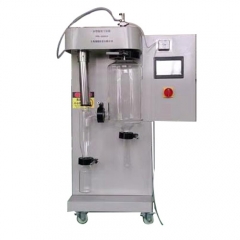
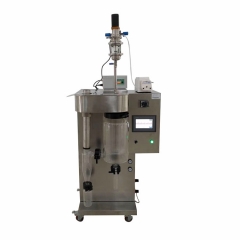
High quality 1.5L scale lab spray dryer equipment
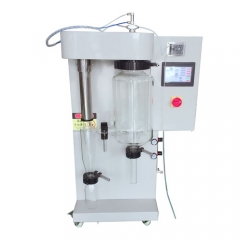
Lab scale spray dryer is suitable for the production of in universities, research institutes and food and pharmaceutical chemical enterprises.
A laboratory cast film machine is designed to produce continuous plastic films and sheets through an extrusion-based casting process. It is widely used in polymer research, new material development, film formulation testing, and process optimization.
Unlike conventional production equipment designed for large-scale manufacturing, a laboratory cast film line allows researchers to investigate material behavior and adjust processing parameters under controlled conditions. It provides a practical platform for studying film formation, thickness, material formulation, and processing performance.
A plastic cast film machine is an extrusion system that converts plastic raw materials into continuous films through a flat die and casting unit.
Plastic pellets are fed into the extruder, where they are heated, melted, and conveyed by a rotating screw. The molten polymer then passes through a flat die to form a continuous film. The film is subsequently handled by the casting and haul-off sections before being collected by the winding unit.
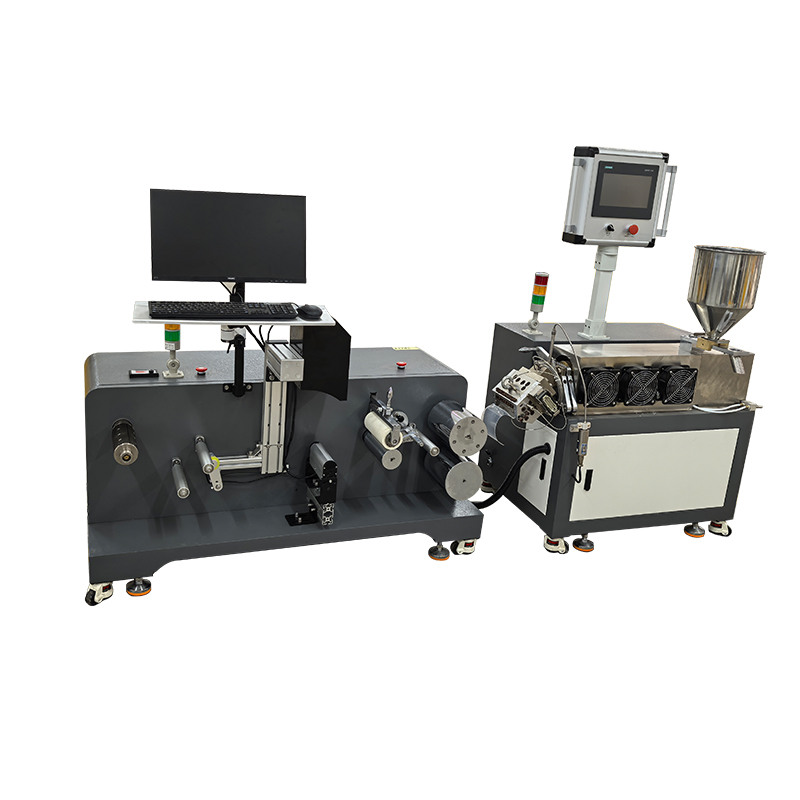
This process enables researchers to evaluate different polymer formulations and investigate how processing conditions influence the resulting film.
A typical laboratory cast film extrusion line consists of several integrated components:
Single-Screw Extruder: Feeds, melts, and plasticizes polymer materials before delivering the melt to the die.
Flat Die: Distributes the molten polymer across the required film width to form a continuous sheet.
Casting and Calendering Unit: Receives the extruded melt and helps form the film into the required shape and thickness.
Haul-Off System: Controls film transportation and helps maintain a stable production process.
Winding Unit: Collects the finished film into a roll for subsequent testing and evaluation.
PLC Touchscreen Control System: Allows operators to adjust and monitor key processing parameters, including speed, temperature, and pressure, depending on the machine configuration.
These components work together to provide a continuous film extrusion and winding process.
The working process generally follows five stages:
Material Feeding: Plastic pellets are introduced into the hopper.
Melting and Plasticization: The screw conveys and melts the material inside the heated barrel.
Film Extrusion: The molten polymer passes through the flat die to form a continuous film.
Casting and Haul-Off: The extruded material is formed and transported through the casting and traction sections.
Film Winding: The finished film is collected for further testing or processing.
During operation, researchers can adjust relevant parameters to investigate film formation and material performance.
Laboratory cast film equipment is available in different configurations according to research requirements.
A single-layer cast film machine is suitable for studying individual polymer materials, evaluating film properties, and developing new formulations.
A multilayer cast film machine allows different polymer layers to be combined into a single film structure. Depending on the configuration, it can support two-layer or three-layer co-extrusion research.
Multilayer configurations are useful for investigating the effects of different material combinations and layer structures on film performance.
Laboratory cast film machines are commonly used in:
New Material Development: Evaluating new polymer formulations and film compositions.
Polymer Property Testing: Preparing film samples for subsequent physical and mechanical evaluations.
Process Optimization: Studying the effects of extrusion speed, temperature, pressure, and film thickness.
Multilayer Film Research: Investigating material combinations and multilayer structures.
Production Quality Control: Preparing samples and evaluating film consistency during process development.
These applications make laboratory cast film equipment useful for universities, research institutes, and polymer processing laboratories.
OLLITAL offers laboratory cast film extrusion systems, including single-layer, double-layer, and three-layer configurations.
The machine is designed to support polymer casting tests, new material formulation development, process optimization, and production quality control. Actual configurations and specifications should be confirmed according to the selected model.
For equipment recommendations or customized configurations, contact the OLLITAL technical and sales team to discuss your materials, film requirements, and research objectives.



 Servicio en línea
 +86 15960821529
 kevin@ollital.comkevinollital@gmail.com
 +86 15960821529
 +8615960821529


